

Educational content only — not financial advice. Rates change quickly; figures are as of late September 2026.
On September 28, 2026, the 10-year U.S. Treasury yield closed at 5.24% — its highest close since June 2007 (U.S. Treasury). That one number quietly changes your mortgage, your car loan, your savings account and the price of almost every stock you own. You don't need an economics degree to understand why. Just one idea: money has a price, and that price is the interest rate.
There are two kinds of "interest rates"
1. The rate the Federal Reserve controls. The federal funds rate is what banks charge each other for overnight loans. On September 16, 2026, the Fed raised it by a quarter point to 3.75–4.00% — its first hike since July 2023, after six cuts in a row. The rate had peaked at 5.25–5.50% in July 2023.
2. The rate the market sets. Treasury bond yields are set every day by millions of buyers and sellers. On September 28, 2026: 3-month 4.28%, 2-year 4.92%, 10-year 5.24%, 30-year 5.56%.
The key idea: the Fed controls the short end; the market controls the long end — and most loans in your life follow the long end.
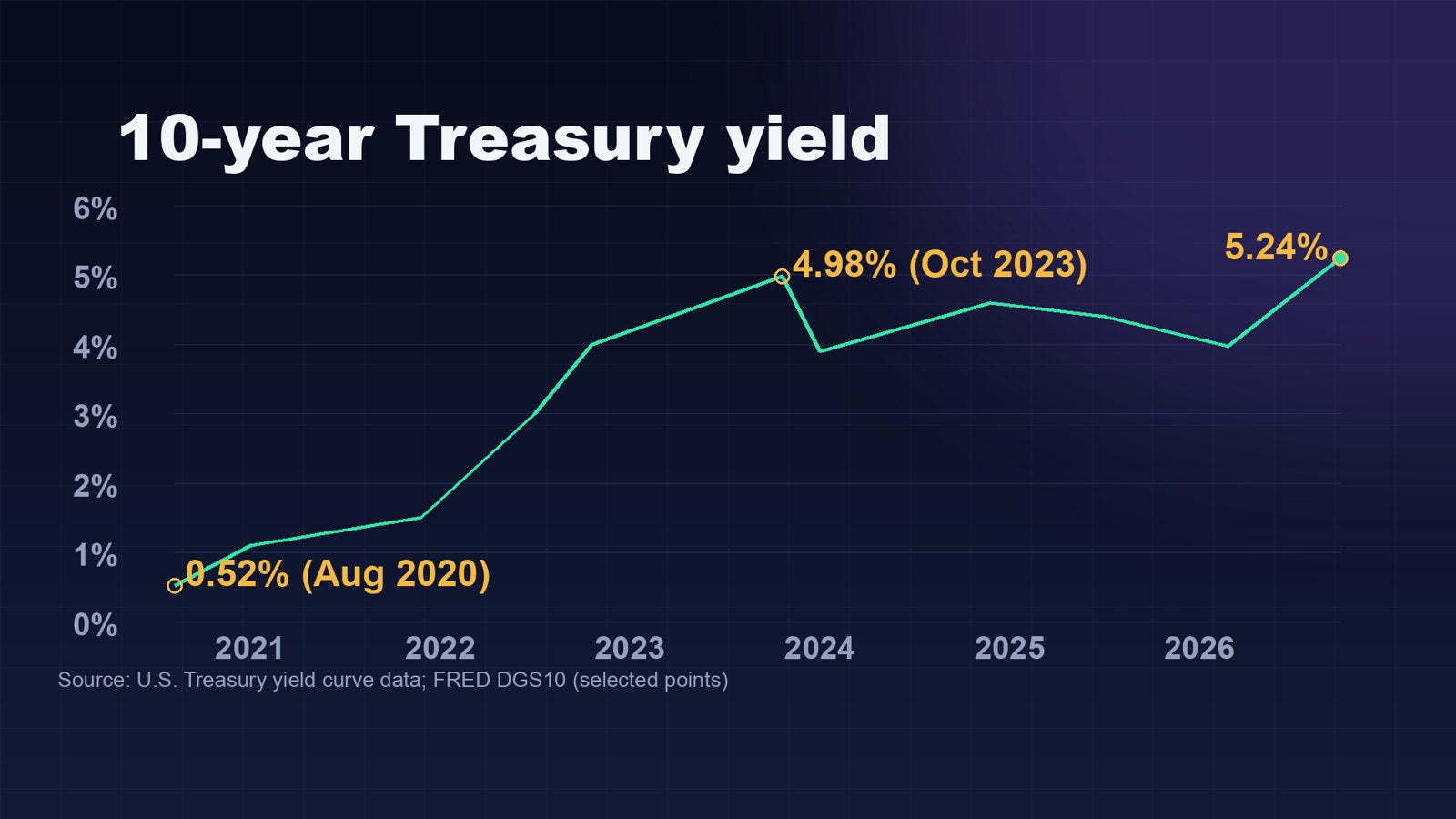
In August 2020 the 10-year yield was about 0.5% — money was almost free. By October 2023 it was close to 5%. Today it's above 5%. Why does that matter? A Treasury is the safest investment in the world; it's the floor every other investment has to beat. When the safe option pays 0.5%, almost anything looks attractive. When it pays 5%, everything else has a tough competitor.
What higher rates do to borrowers
Mortgage rates follow the 10-year yield more closely than the Fed. That's why the average 30-year fixed mortgage hit 7.03% in the week of September 24, 2026 (Freddie Mac), even though the Fed's rate is below 4%.
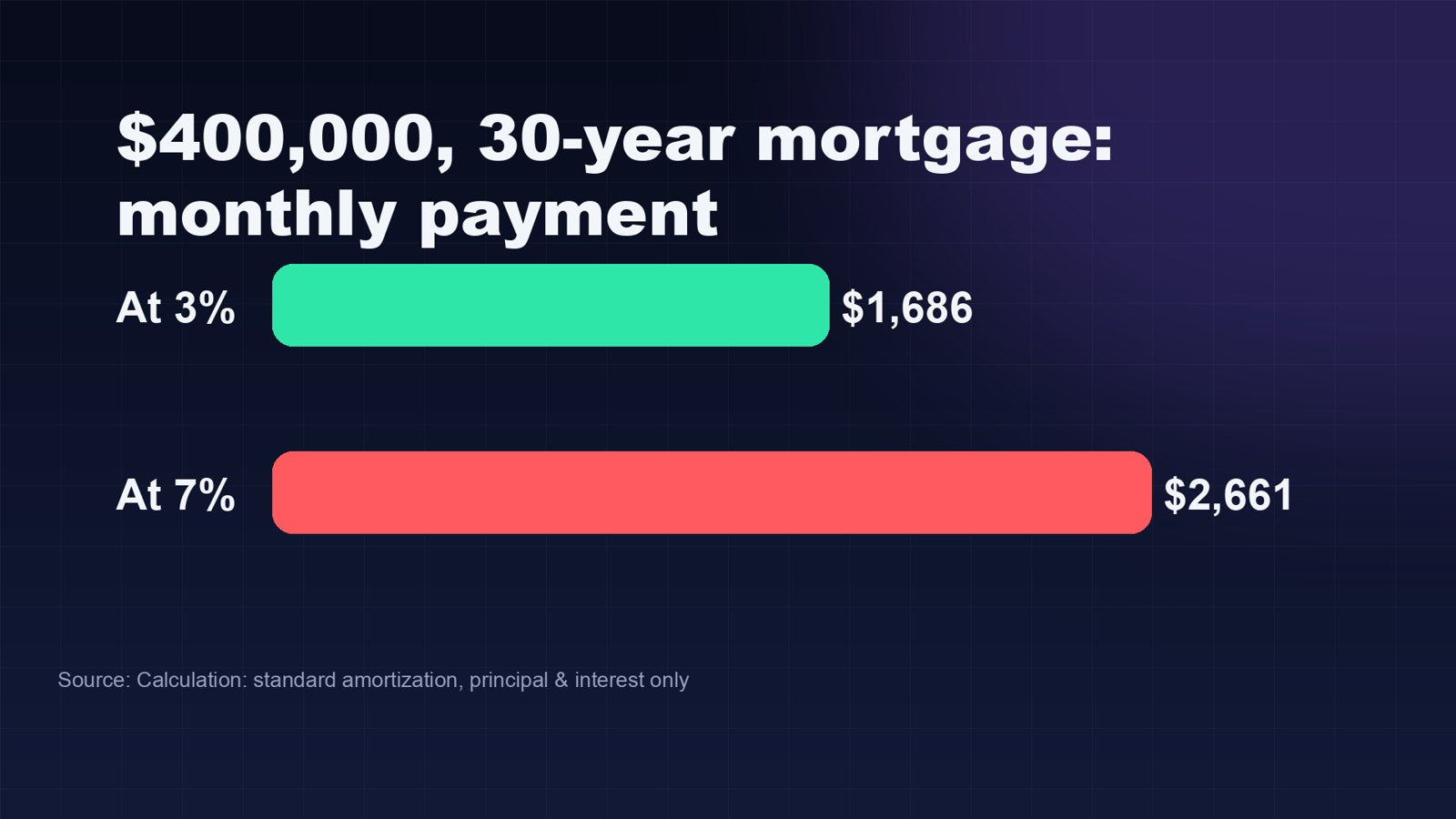
On a $400,000, 30-year mortgage, the monthly payment (principal and interest) is about $1,686 at 3% and about $2,661 at 7%. Same house, same buyer — about $975 more every month, or roughly $351,000 of extra interest over 30 years (our calculation, standard amortization).
It's not just houses. The average new-car loan was about 9.49% in August 2026 with a typical payment of about $770 (Cox Automotive / Moody's), and credit cards averaged about 22.15% on balances charged interest (Fed G.19, Q2 2026). Businesses feel it too: when borrowing costs more, some factories, stores and projects stop making sense and get delayed or cancelled. That's the point — the Fed raises rates on purpose to cool demand when inflation is too high. Its September projection put 2026 inflation (PCE) at about 3.7%, well above its 2% target.
The saver's side
Higher rates can work for savers — but only if they move their money. The U.S. national average savings rate is just 0.37% (FDIC, Sep 21, 2026), while top online savings accounts pay around 4% (comparison sites, indicative). On $10,000, that's the difference between about $37 and about $420 a year.
Bonds work similarly: new bonds pay more income when yields rise. But there's a catch — when rates go up, existing bond prices go down. If you own a bond paying 2% and new bonds pay 5%, nobody wants yours at full price, so its price has to fall until it's competitive.
The hidden math behind stock prices
Why do stocks fall when rates rise, even if nothing changed at the company? Because of discounting: a dollar in the future is worth less than a dollar today, and how much less depends on the interest rate.
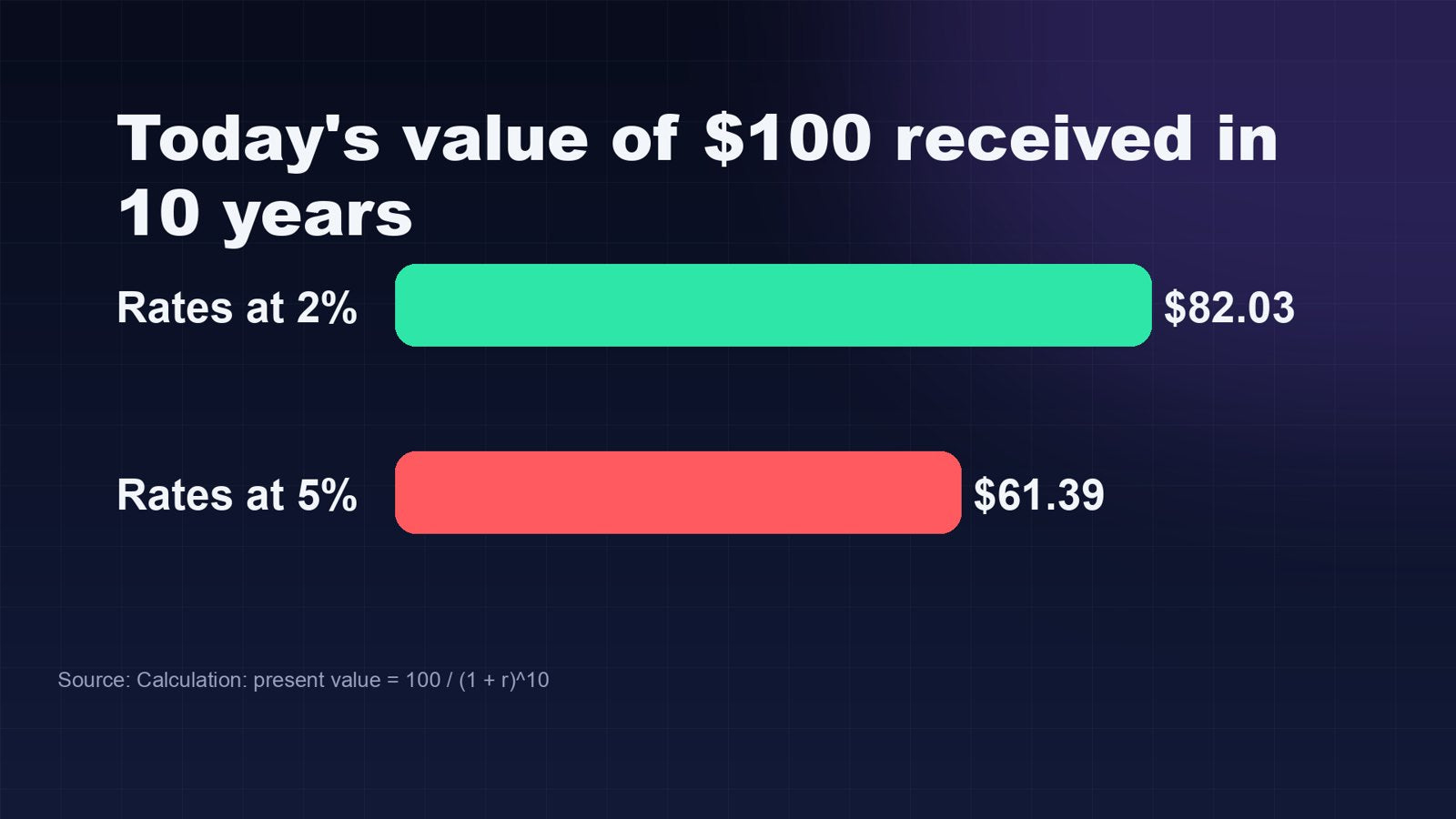
$100 promised in ten years is worth about $82.03 today at 2%, but only about $61.39 at 5% (present value = 100 / (1 + r)10). Nothing about the promise changed — only the rate — and its value dropped by about a quarter. A stock is essentially a promise of future profits, so when rates rise, those profits are worth less today and investors pay less. Fast-growing companies whose profits are furthest in the future are hit hardest.
2022: the proof
In 2022 the Fed raised rates faster than it had in decades. The S&P 500 fell about 18% including dividends, the Nasdaq Composite about 33%, and the main U.S. bond index about 13% — its worst year since it began in 1976. Stocks and bonds fell together, because the one thing they both depend on — the price of money — changed very quickly.
It's happening everywhere
- Australia (RBA): raised to 4.60% (Sep 29, 2026)
- U.S. (Fed): 3.75–4.00% (Sep 16, 2026)
- U.K. (Bank of England): held at 3.75%, with three of nine members voting to hike (Sep 17, 2026)
- Eurozone (ECB): deposit rate raised to 2.50% (Sep 10, 2026)
- Canada (BoC): held at 2.25% (Sep 2, 2026)
What this means for you (questions, not advice)
- If you borrow: is any of your debt variable-rate? Fixed-rate mortgages lock the payment; variable loans and card balances can get more expensive as rates rise.
- If you save: what does your account actually pay?
- If you invest: is your time horizon long enough to ride out rate-driven drops like 2022? Are you reacting to headlines or to your plan?
You can't control what the Fed or the bond market does. You can control how exposed you are — and that starts with understanding it.
📊 Model your own loan payments and budget with our Excel dashboard templates.
▶️ Watch the full video on our YouTube channel. Previous: Who Actually Makes the Money From AI? · Start the series: If I Had $10,000 to Invest in 2026
Sources
- Federal Reserve — FOMC statement and Summary of Economic Projections (Sep 16, 2026); open market operations history; G.19 Consumer Credit (Q2 2026)
- U.S. Treasury — Daily Par Yield Curve Rates (Sep 28, 2026); FRED DGS10
- Freddie Mac — Primary Mortgage Market Survey (Sep 24, 2026)
- Cox Automotive / Moody's — Vehicle Affordability Index (Aug 2026)
- FDIC — National Rates and Rate Caps (Sep 21, 2026)
- Bank of England (Sep 17, 2026); ECB (Sep 10, 2026); Bank of Canada (Sep 2, 2026); Reserve Bank of Australia (Sep 29, 2026)
- CNBC (Dec 30, 2022; Jan 7, 2023); A Wealth of Common Sense (Jan 2023)
- Mortgage and present-value figures: author's calculations using standard formulas
Disclaimer: Educational content only — not financial advice. Mortgage and present-value numbers are illustrative calculations (principal and interest only). Rates change quickly; check the latest figures. Consider speaking with a licensed professional about your situation.

Share:
AI Companies Are Spending $700 Billion. Who Actually Makes the Money?