

An industry explainer, not investment advice. Company figures are from filings and reports as of September 2026 and change every quarter.
In 2026, just four companies — Microsoft, Alphabet, Amazon and Meta — plan to spend somewhere around $720–745 billion on capital projects, mostly the machines that run artificial intelligence (sum of company guidance, July 2026). That's more than the entire economy of most countries, spent in a single year. So where does all that money actually go — and who ends up keeping it? Let's follow one dollar from the AI app you pay for all the way down to the power plant.
The spenders
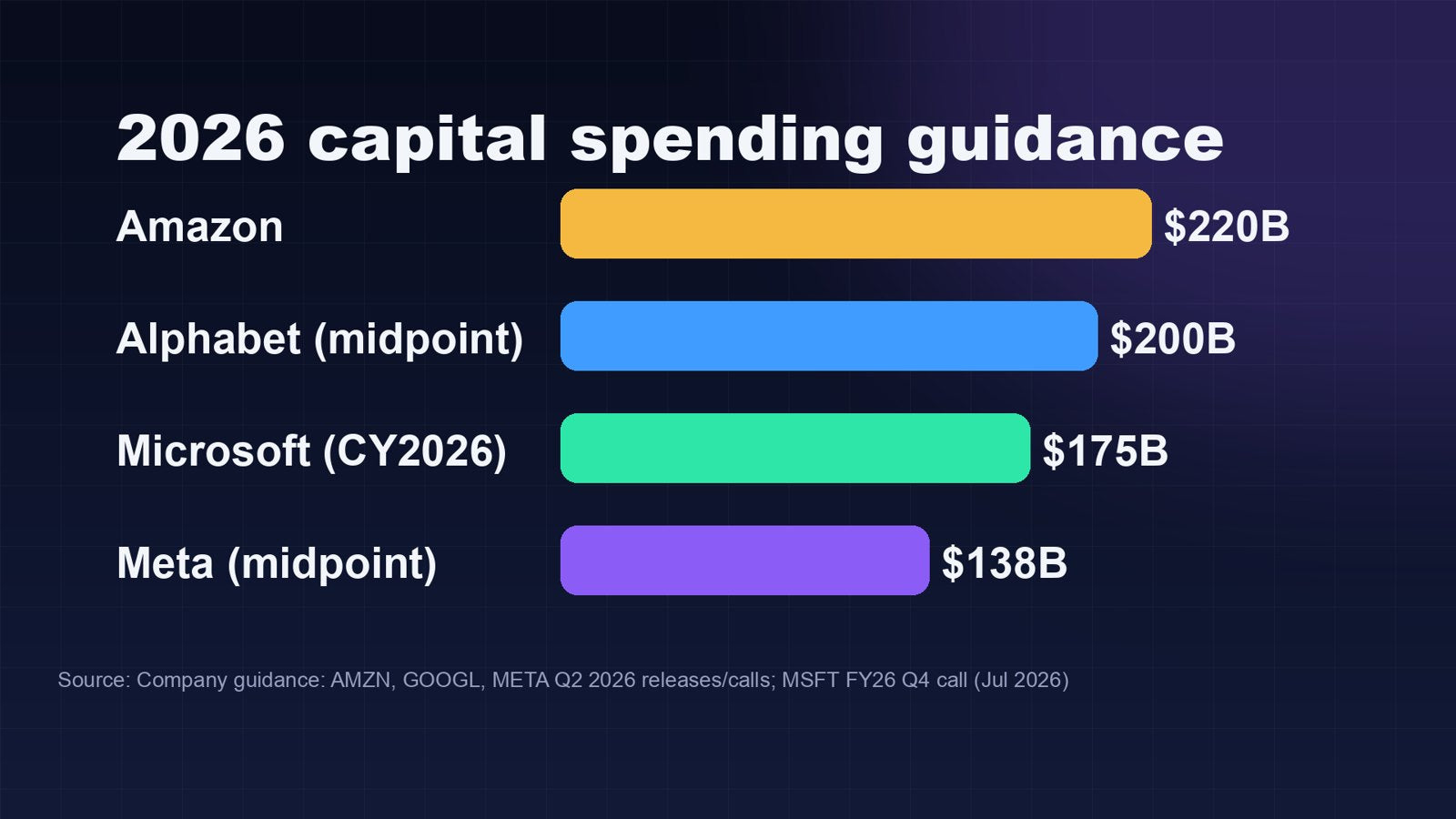
- Amazon: about $220B guided for 2026 (raised, partly due to higher memory costs)
- Alphabet: $195–205B
- Microsoft: about $175B for calendar 2026 (restated from ~$190B only because of an accounting change)
- Meta: $130–145B
For context, Microsoft's capital spending jumped from $64.6B in fiscal 2025 to $115.9B in fiscal 2026. The International Energy Agency says the biggest tech companies spent over $400 billion in 2025 and expects roughly +75% in 2026.
Layer 1 and 2: users and AI software
You pay for an AI subscription, or your company pays for AI inside its software. OpenAI said ChatGPT reached 900 million weekly users and 50 million paying subscribers (February 2026). Google reports around 950 million monthly users for the Gemini app, and Microsoft over 30 million paid Copilot seats. Most users pay nothing — and somebody has to pay for all those data centers.
On revenue, Microsoft says its AI business passed a $37 billion annual run rate (March 2026). Bloomberg reported that OpenAI's annualized revenue topped $40 billion in August 2026, citing unnamed sources — OpenAI is private, so treat that as an estimate. Tens of billions of revenue sounds enormous, until you compare it with hundreds of billions of spending.
Layer 3: the cloud landlords
Most AI software rents computing from cloud providers, and the cloud is booming. In the latest quarter: Microsoft Azure +43%, AWS $42.2B (+37%), Google Cloud $24.8B (+82%), and Oracle's cloud infrastructure +121%. The twist: the cloud landlords are the same companies doing the spending — they build data centers, rent the capacity out, and hope the rent pays it back. Oracle reports $664 billion of signed future contracts, but a signed contract is a promise, not cash in the bank.
Layers 4 and 5: the shovel sellers
In the California gold rush, many of the steadiest fortunes went to the people selling picks and shovels. In the AI boom, the shovel seller is easy to spot.
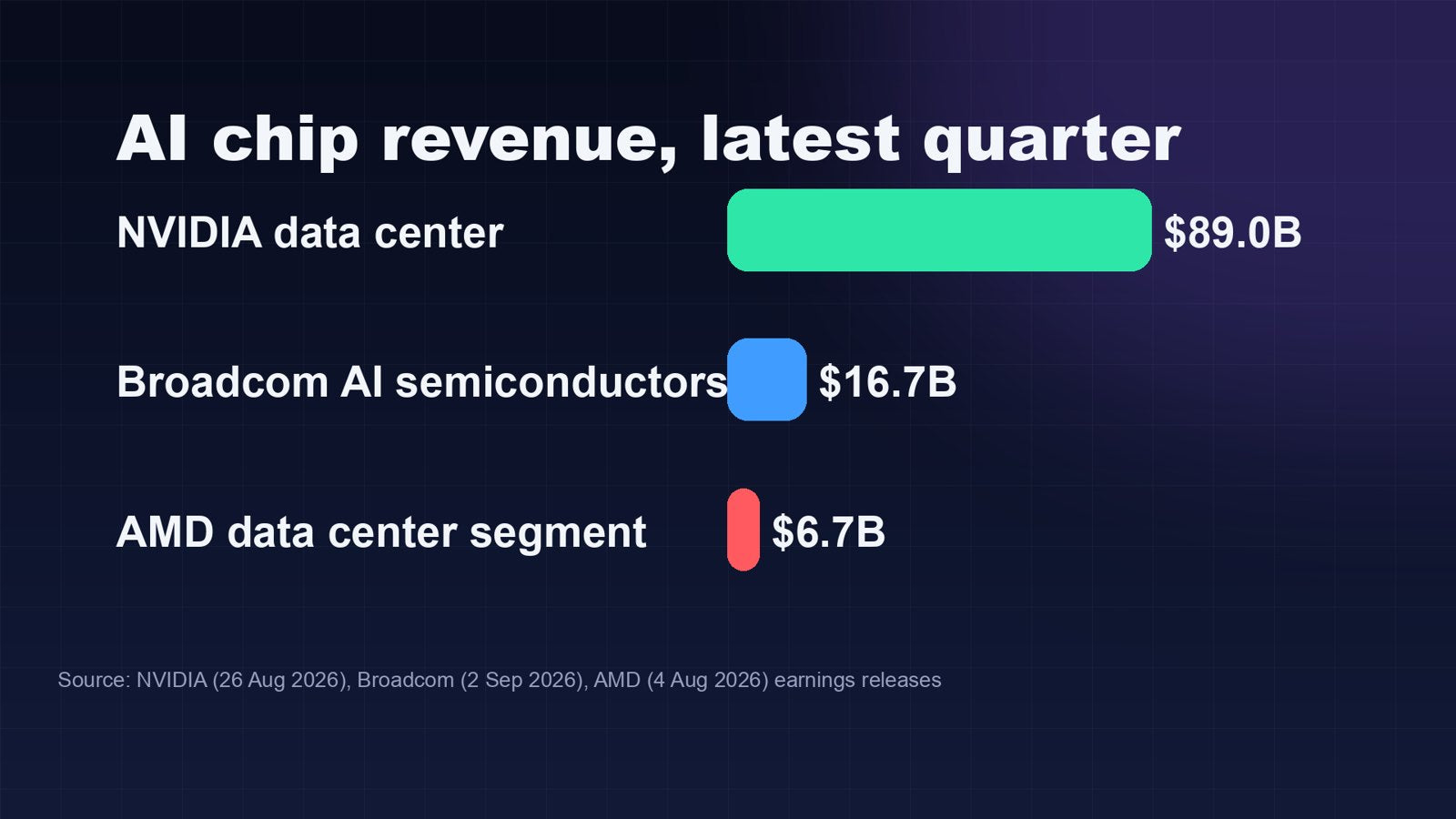
In the quarter ended July 26, 2026, NVIDIA reported $96.2B in revenue, $89.0B of it from data centers (+117%), at a 75% gross margin. Broadcom, which designs custom AI chips and networking chips, reported AI semiconductor revenue of $16.7B (+221%). AMD's data center segment grew 107% to $6.7B. And most advanced AI chips are manufactured by TSMC, which reported about $40.2B of Q2 revenue at a 67.7% gross margin.
The surprise winner: memory
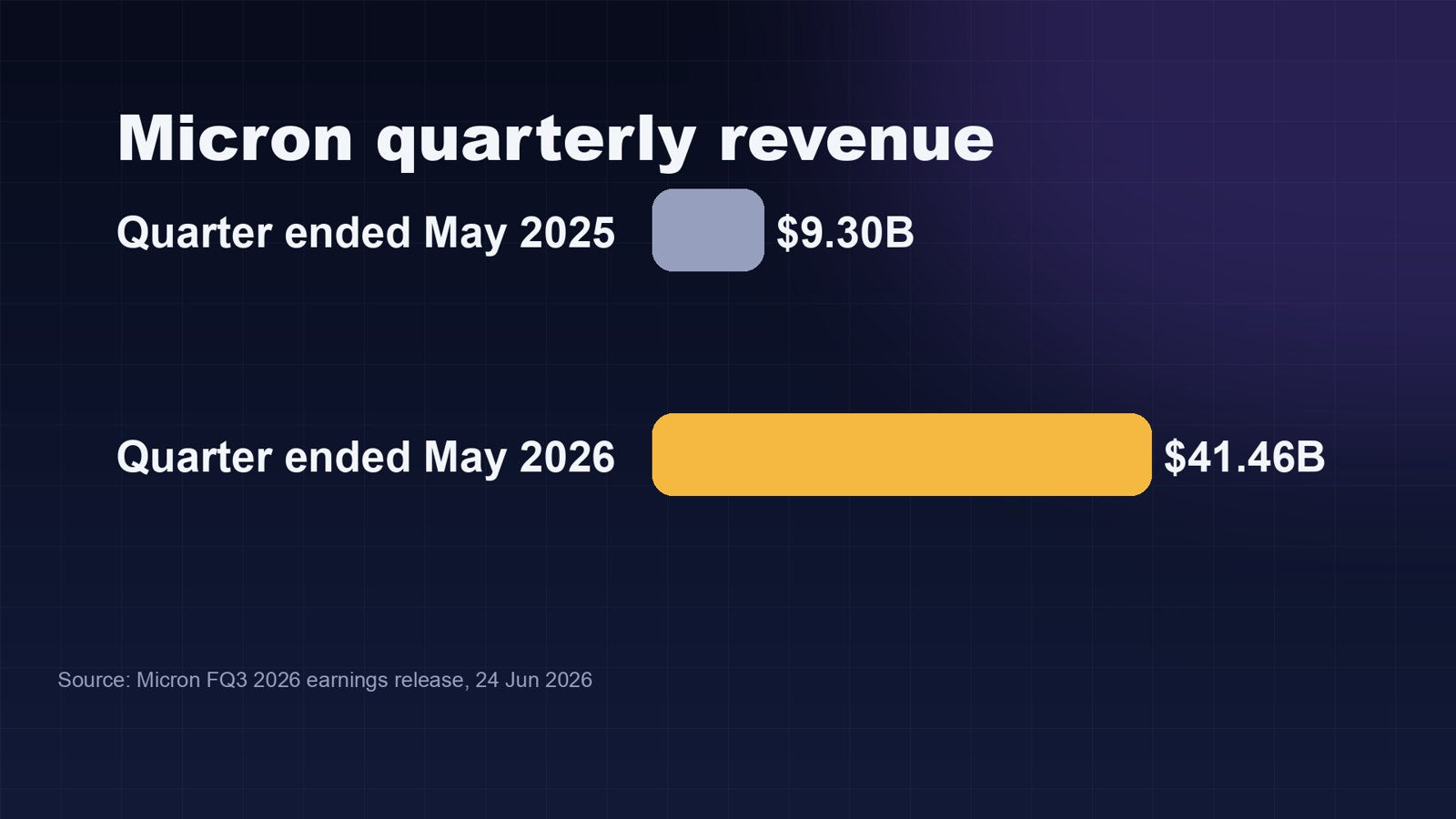
AI chips need very fast high-bandwidth memory, made mainly by SK hynix, Samsung and Micron. Micron's revenue in the quarter ended May 2026 was $41.46B, versus $9.30B a year earlier, at an 84.6% gross margin. SK hynix reported a record 76% operating margin. When Amazon raised its 2026 spending plan, higher memory costs were part of the reason: the spenders' costs became the memory makers' profits.
Networking, power and cooling
A modern AI system is thousands of chips working together. Networking company Arista just posted its first $3B+ quarter (+37.7%).
Then there's electricity. The IEA estimates data centers used about 415 TWh in 2024 (about 1.5% of world electricity), about 485 TWh in 2025, and roughly 950 TWh by 2030. In the U.S., data centers used 4.4% of all electricity in 2023; the Department of Energy projects 6.7–12% by 2028. Dominion Energy in Virginia has reported more than 53 GW of data-center capacity in various contracting stages. And cooling and power equipment maker Vertiv ended 2025 with a $15.0B order backlog, more than double the year before.
The full money map
- User — subscriptions and business plans
- AI software — OpenAI, Microsoft, Google
- Cloud — Azure, AWS, Google Cloud, Oracle
- Data centers — ~$720–745B of 2026 capex
- Chips & memory — NVIDIA, Broadcom, TSMC, Micron, SK hynix
- Networking — Broadcom, Arista
- Power — utilities such as Dominion
- Cooling & equipment — e.g. Vertiv
The $600 billion question
Today, the bottom of this chain — chips, memory and suppliers — is already booking record profits. The money at the top, from actual users, is still much smaller than the money being spent. In 2024, David Cahn at Sequoia called this "AI's $600B question": to justify the build-out, AI needs to generate hundreds of billions of dollars of revenue a year. That's an opinion, and plenty of smart people disagree — but it's the right question to ask.
Two paths are possible (neither is a prediction): if AI revenue keeps growing fast, today's spending looks smart and the whole chain keeps winning. If it grows slower than hoped, the spenders may cut back, and the suppliers at the bottom — whose customers are highly concentrated — would feel it first.
So who makes the money from AI? Today, mostly the shovel sellers. Tomorrow, whoever gets paid by the end user. That's the story to watch.
📊 Build your own analysis with our Excel and Power BI dashboard templates.
▶️ Watch the full video on our YouTube channel. Previous: S&P 500 vs Picking Individual Stocks · Next: Why Interest Rates Change Everything
Sources
- Microsoft FY26 Q3 and Q4 earnings releases (SEC 8-K); CFO Dive (Jul 30, 2026)
- Alphabet Q4 2025 and Q2 2026 releases (SEC); Amazon Q4 2025 and Q2 2026 releases (SEC); Meta Q4 2025 and Q2 2026 results; Oracle Q1 FY27 release (Sep 10, 2026); CNBC (Jul 2026)
- NVIDIA Q2 FY27 release (Aug 26, 2026); Broadcom Q3 FY26 (Sep 2, 2026); AMD Q2 2026 (Aug 4, 2026); TSMC Q2 2026 (Jul 16, 2026)
- Micron FQ3 2026 release (Jun 24, 2026); SK hynix Q2 2026; Arista Q2 2026; Vertiv Q4 2025 (Feb 11, 2026); Dominion Energy Q2 2026 (via Virginia Business)
- OpenAI via TechCrunch (Feb 27, 2026); Bloomberg (Aug 13, 2026, reported estimate)
- IEA — Energy and AI (Apr 2025); Key Questions on Energy and AI (Apr 2026); U.S. DOE / LBNL 2024 Data Center Energy Usage Report
- Sequoia Capital, David Cahn, "AI's $600B Question" (Jun 20, 2024) — opinion
Disclaimer: Educational industry explainer — not investment advice or a recommendation to buy or sell any security. Some figures are reported estimates and are labelled as such.

Share:
S&P 500 vs Picking Individual Stocks: What Actually Makes Sense?
The 10-Year Just Hit 5%: Why Interest Rates Change Everything